
Your AI Agent Can Now Split Big Jobs Across a Team of Subagents
You give your AI agent a big, multi-step job and it plods through it one piece at a time. It works, but it's slow, and the longer the task runs the more it costs you.
There's a better way now. Your Managed Agent can split a complex job into smaller focused tasks, hand each one to a specialised subagent, and run the independent ones at the same time.
What landed
Managed Agents can now build and run subagents. The main agent stays in charge - it breaks the work down, delegates each piece, reviews what comes back, and gives you one tidy final answer.
Each subagent only gets the tools and information it needs for its own job. Nothing more. The main agent handles the planning and reasoning, while lightweight models do the focused tasks underneath.
What that gives you
- Bigger jobs, handled: large tasks get split into manageable pieces instead of one long chain.
- Faster results: independent tasks run in parallel rather than one after another.
- Lower cost: each subagent works with a small slice of context instead of the whole conversation, so you burn fewer tokens.
- Safer execution: read-only tasks can't change your records, and the main agent reviews any customer messages before they go out.
Subagent usage is billed as part of the parent agent's run, so there's nothing new to track on that front.
How to use it
- Go to AI Agents, then Agent Studio, then Managed.
- Create or open a Managed Agent and describe the task you want done in plain language.
- The AI Builder works out whether subagents are needed and sets them up for you. No extra configuration required.
- If you'd like to be explicit, you can ask it to "split this task into subagents" or "add a subagent to handle calendar operations".
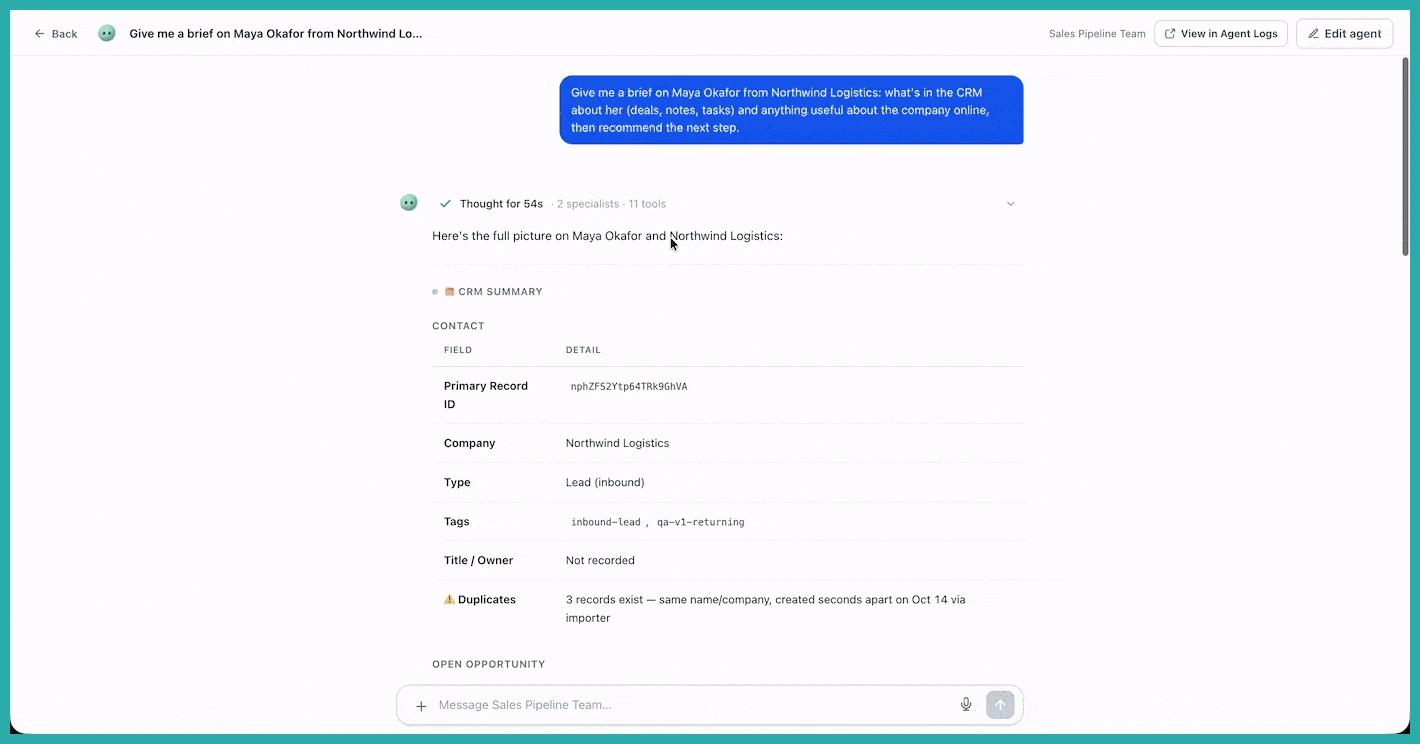
- Run your agent, then select View subagent activity to watch the work get delegated and done.
In the screenshot below, you'll see the subagent activity view, where you can inspect each task, its execution steps, the results, and any changes made.
A real example
Say you give your agent this: "Every Monday, identify opportunities that haven't progressed in the last 14 days, check their recent conversations, and create follow-up tasks for the assigned owners."
Your Managed Agent can split that across three helpers - one to find the stalled opportunities, one to review the recent conversations, and one to create the follow-up tasks for each owner. The main agent coordinates all of it and hands you a single summary.
This works across chat, triggers, scheduled runs, follow-ups and API runs, and it plays nicely with your existing knowledge bases, memory and custom values.
Next time you hand your agent something big, let it build its own team. Open a Managed Agent, describe the job, and watch the work split itself.
