All-in-One Software for Small Businesses: What It Is and Do You Need It?
Why ESC Hub Is the Smarter Way to Simplify and Scale
You did not start a business to spend your evenings troubleshooting why your email automation is not talking to your CRM.
But here you are.
Logging into one platform to check your leads. Another to send a campaign. A third to see if that booking came through. And somewhere in the middle of all that, the work you love, the reason you started, gets squeezed into whatever time and energy is left.
If that sounds familiar, you are not doing it wrong. You have just outgrown the patchwork.
Most online business owners are running on five, six, sometimes ten different tools that were never designed to work together. And the cost is not just financial, though that adds up fast. It is the mental load. The constant switching. The nagging feeling that something, somewhere, is not firing correctly.
That is exactly the problem ESC Hub was built to solve. Not by adding another tool to the pile, but by replacing the pile entirely. One platform. Everything connected. And a team behind it that helps you use it.
Let's talk about what all-in-one software is, whether you really need it, and what it looks like in practice.
What Is All-in-One Software?
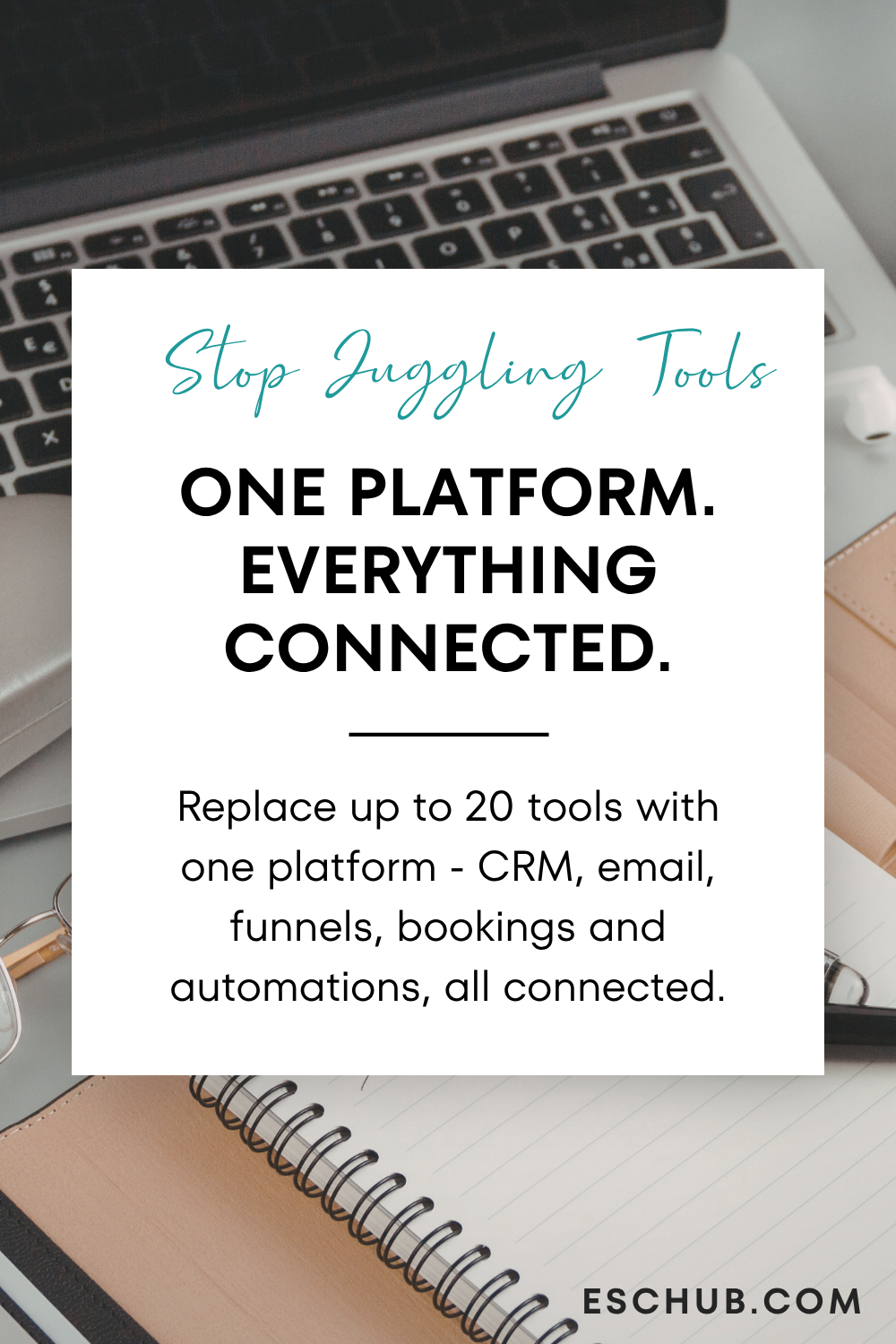
All-in-one software is a single platform that handles the core jobs of running and growing your business, instead of a separate tool for each one. Rather than paying for an email platform, a funnel builder, a booking tool, a CRM and a course platform separately, everything lives in one place under one login.
A well-built all-in-one platform for a small business covers most or all of these:
- CRM: contacts, leads and follow-up
- Email marketing and automated sequences
- Sales funnels and landing pages
- Websites
- Booking and calendar management
- Course, programme and community hosting
- Payments
- Reporting
- Automation connecting all of the above
The tools talk to each other because they are built into the same system. A lead comes in through your landing page, goes straight into your CRM, starts an automated email sequence and books a call, without you moving data between platforms or worrying about integrations breaking. In business terms, that gives you something hard to put a price on: clarity.
ESC Hub was designed as true all-in-one business software. Your contacts, campaigns, funnels, automations, payments and analytics all live inside one system, connected by default, not bolted together with hope and Zapier.
Why All-in-One Software Is Becoming Essential for Small Businesses
Small businesses are not failing for lack of ambition. They are stalling because of complexity.
The modern business owner is expected to generate leads, nurture them, make sales, deliver services, follow up automatically, track the numbers and still create content. When those jobs are scattered across five to eight different tools, momentum slows. Fast. And the tool count keeps climbing: BetterCloud reports the average company now runs 118 SaaS apps, up from 106 the year before. For a solo online business that usually means somewhere between four and eight tools, each with its own login, its own billing date, its own quirks and its own monthly cost.
Here is why demand for all-in-one business software keeps growing.
1. Tech Overwhelm Is Real
Tool fatigue is one of the most common challenges business owners face. Every platform has a learning curve. Every update changes how things work. Every integration is another potential weak point.
ESC Hub removes this by putting your core systems in one place. When everything lives inside one dashboard, getting things done gets simpler, and you finally do the things you have been putting off because the setup felt too hard.
2. Software Costs Add Up Fast
Most business owners pay separately for email marketing, a CRM, a funnel builder, automation tools, a booking system, SMS and reporting. The combined monthly cost is often shocking once you add it up, and all of it for tools that do not talk to each other properly. If you want to see the numbers, this breakdown of what a typical tool stack costs each month lays it out in full.
An all-in-one platform brings those costs together and removes the overlap. ESC Hub is $97 a month, and that includes 20,000 emails, then $1 per 1,000 after that. See what running your whole business on one platform for under $100 a month looks like in practice.
3. Broken Integrations Kill Momentum
When separate tools depend on outside connections to talk to each other, even a small update can break the automated sequences that run your business behind the scenes. Leads do not get tagged. Emails do not send. Pipelines do not update. And you spend your Tuesday evening troubleshooting instead of growing your business.
ESC Hub avoids this because the CRM, funnels, automations and campaigns are all part of the same platform. There are no patched-together connections between them to fail.
4. Data in One Place Means Smarter Decisions
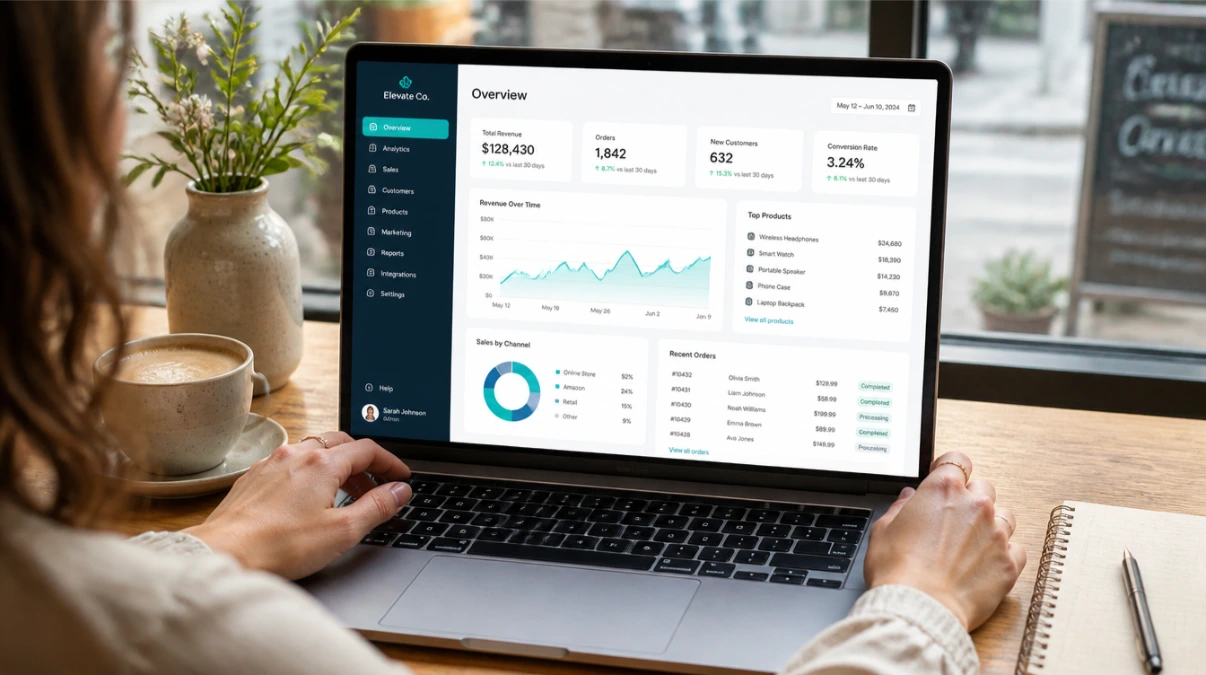
Data spread across platforms is almost impossible to make sense of. Inside ESC Hub, you can see where leads come from, how they move through your pipeline, which campaigns convert and the revenue tied directly to your marketing.
When you can see everything in one place, you stop guessing and start deciding.
The 5 Core Systems Every Online Business Needs
Before we go deeper on the software, let's step back for a moment.
Every sustainable online business runs on five core systems. Not tools. Systems.
1. Lead Generation
How new people find you: landing pages, forms, content and ads.
2. Lead Nurture
How you build trust over time: email sequences, follow-ups and helpful content that makes you the go-to person.
3. Sales
How you turn interest into revenue: funnels, pipelines and payment processing.
4. Delivery
How you deliver what you sell: onboarding, membership access and scheduling.
5. Retention
How you keep customers engaged and buying again: re-engagement campaigns, upsells and ongoing communication.
Most business owners are not struggling for lack of effort. They are struggling because these systems are disconnected. ESC Hub houses all five inside one platform, and that is what makes all-in-one software so useful. It supports complete business systems, not isolated tools.
The Hidden Cost of Running Your Business on Separate Tools
Most business owners think the cost of multiple tools is just financial. It is not.
It is mental.
Every time you log into a different platform, you switch context. You stop thinking about your clients. You start thinking about software.
When your systems are fragmented, you spend time checking whether integrations fired, making sure tags applied, troubleshooting automations and exporting reports from one tool to import into another. That is not growth work. That is maintenance work.
Over time, this creates something subtle but dangerous: operational drag. You hesitate before launching because setup feels heavy. (It does not have to: here is how to set up business software without overwhelming yourself.) You put off automation because it feels complex. You avoid improving your funnels because it means touching three different systems.
All-in-one software removes that friction. When everything lives inside ESC Hub, you move faster, because there are fewer moving parts between you and the work that matters.
Do You Really Need All-in-One Business Software? The Signs
You probably already know something is wrong. You just have not connected it to your tool stack yet.
You are spending time on admin that should be automatic
Manually adding contacts to your email list after a booking. Copying lead details from one platform to another. Sending follow-up emails by hand because the automation did not fire. These are integration gaps, and they exist because your tools were not built to work together.
Something breaks and you do not know where to look
A payment does not process. A new client does not receive their onboarding email. A booking confirmation goes to the wrong address. When your business runs across four or five platforms, finding the source of a problem means logging into each one separately. One place to check when something goes wrong is one of the first differences people notice after they consolidate.
Your tool costs have crept up without you noticing
Subscriptions added one at a time rarely feel expensive. Added together, they often are. If you have not looked at the total recently, it is worth doing.
If you are running an online business and managing more than two or three separate tools, the honest answer is yes, you need it, or you will soon. Not because all-in-one software is the fashionable answer, but because fragmented tools create friction, and friction costs you money, time and the energy that should be going into your business.

Is Your Business Ready for All-in-One Software? A Quick Self-Audit
Before switching platforms, it helps to be honest about where your systems are right now. Score each statement from 1 (not true at all) to 5 (absolutely true):
- I know exactly where all my leads are stored
- My automations rarely break
- I can track revenue by campaign
- I use fewer than three business platforms
- I feel confident finding my way around my current tools
- My onboarding runs automatically
- I can see every step from first click to paying client
- I do not duplicate data across tools
- I am not paying for software I barely use
- I spend less than three hours a week managing tech
Score guide:
- 10 to 25: Your systems are fragmented and are costing you time, energy and probably money too. This is the clearest sign that consolidating would change things for you.
- 26 to 40: You have some structure, but there is still more complexity than there needs to be. An all-in-one platform would simplify things considerably.
- 41 to 50: You are already fairly organised. ESC Hub could still help you consolidate further and give you coaching and community support alongside your tools.
The Honest Pros and Cons of All-in-One Software
Let's be straight about this, because a platform that only tells you the good stuff is not one you should trust.
The Real Advantages
- Simplicity: one place for everything
- Lower overall cost than running multiple subscriptions
- Data in one place that actually makes sense
- No more broken connections between tools breaking your automations without warning
- Faster progress because there are fewer moving parts
The Honest Considerations
- Migration needs planning. You cannot just flip a switch.
- Learning any new system takes a little time upfront.
- Some businesses with highly specialised enterprise needs may need custom solutions.
For most small and mid-sized online businesses, simplicity wins. And with ESC Hub, you are not migrating alone. Our team is there with you through the whole process.
Who Should Use ESC Hub's All-in-One Software?
ESC Hub is built for coaches, consultants, service providers, course creators, membership site owners and anyone building an online business.
If you manage leads, nurture prospects, sell offers and deliver online, you need an integrated system. ESC Hub was created for overwhelmed business owners who want one connected system instead of six dashboards.
It is not built for enterprise software companies with in-house development teams. It is built for business owners who want clarity, control and a team that supports them.
Who it probably is not for yet: a freelancer with one or two clients who only needs an invoice tool and a calendar link. If your business is that simple, a full all-in-one platform is more than you need right now. There is no shame in that. It just means the timing is not right yet.
When All-in-One Software Becomes a Strategic Advantage
There is a moment in most businesses where complexity becomes the bottleneck. It usually happens when you start running paid ads, launch a second offer, build a nurture sequence or create several ways for people to come into your business.
Suddenly you are trying to connect opt-ins, pipelines, follow-ups, payments, onboarding and upsells across half a dozen tools that were not designed to work together.
Inside ESC Hub, those insights sit in one place. Which funnel converts best. Where leads drop off. Which campaign produces revenue. What stage customers are stuck in.
That changes how you make decisions. Instead of guessing, you improve. Instead of reacting, you adjust on purpose. All-in-one software stops being about convenience and starts being about control.
What This Looks Like in Real Life
Imagine running your business across Mailchimp, Calendly, Stripe, ClickFunnels, HubSpot and Zapier. Six dashboards. Several subscriptions. Endless integrations.
After consolidating into ESC Hub:
- Leads opt in through one funnel
- They enter one CRM
- They are tagged automatically
- They receive a nurture sequence
- They book through a built-in calendar
- Payments trigger onboarding instantly
Instead of managing tech, you focus on clients. That is the shift.
What to Look for in the Best All-in-One Software
Not every platform labelled "all-in-one" delivers true integration. If you are comparing platforms, this guide on how to choose all-in-one business software goes through the questions to ask. Here is what matters most.
1. A Proper CRM
Your CRM is the backbone of everything. ESC Hub's CRM lets you track contacts, segment your audience, tag behaviour, manage pipelines and trigger automations, all from one place.
2. A Real Business Automation Workflow
Automation should reduce manual work, not create new complexity. ESC Hub supports email sequences, SMS follow-ups, automations that fire when someone takes an action, sequences linked to where someone is in your sales process, and onboarding sequences. When someone takes action, the system responds without you having to be there.
3. Funnel and Website Builder
ESC Hub's drag-and-drop builders connect directly with your CRM and automations. When a lead opts in, they are instantly inside your system. No manual steps, no delays.
4. Integrated Payments
When someone buys, they are tagged in the CRM, automation begins, onboarding starts and revenue is tracked. No manual syncing. No crossing your fingers that Zapier fired.
5. Reporting and Analytics
Lead flow, conversion rates, pipeline value, campaign performance and revenue tracking, all in one place. Data that tells you what to do next.
6. Support, Coaching and Community
Here is where ESC Hub is genuinely different. Alongside the software, you get training and support, daily coaching calls and 24/7 live chat, plus access to The Escape Club community, monthly masterclasses, guest expert sessions and live networking calls. We are a people-first, female-led team, and we care about how your business is doing, not just whether you logged in.
Because tools without direction create confusion, and confusion is exactly what most people are already drowning in when they arrive here.
How to Transition to All-in-One Software Without Breaking Your Business
The most common reason people do not switch to an all-in-one platform is not the cost. It is the migration. Moving contacts, rebuilding sequences and recreating landing pages sounds like a project, and projects take time most business owners do not feel they have.
That hesitation is understandable. It is also worth examining honestly. If your current setup is costing you a few hundred dollars a month and hours of manual admin every week, the time you spend migrating pays you back quickly. The question is not whether the migration takes effort. It is whether staying where you are is really the easier option, or just the more familiar one.
Switching does not have to be chaotic. Here is a simple step-by-step:
- Audit your current tools. List every platform you pay for, spot the overlaps and highlight what you barely use.
- Map your core systems. Write down how a lead moves from stranger to client. Clarity before consolidation.
- Clean your contact data. Remove duplicates, archive inactive contacts and import clean data into ESC Hub.
- Rebuild one funnel first. Start with your best-performing funnel and test it before expanding.
- Migrate automations gradually. Rebuild your automated sequences on purpose rather than copying chaos.
- Cancel old subscriptions. Once everything is working, remove the cost and the clutter.
Moving slowly and deliberately gives you long-term stability. And you will not be doing any of it alone: the ESC Hub team works through the setup with you. For more on the practical side, this guide on how to switch platforms without losing data walks through what to expect.
Frequently Asked Questions
What is all-in-one business software?
It is a single platform that covers the core jobs of running an online business, such as CRM, email marketing, funnels, bookings, payments and automation, so you are not paying for and connecting a separate tool for each one.
Do I really need all-in-one business software?
If you are running an online business on more than two or three separate tools, most likely yes, or you will soon. If you are a freelancer with one or two clients who only needs invoicing and a calendar link, you can probably wait.
Is all-in-one software suitable for beginners?
Yes, and beginners often benefit most. You avoid building a fragmented stack from the start and set yourself up with clean systems from day one. Building it inside one platform now is a lot easier than building it across five tools and migrating later.
Can I migrate from my current CRM?
Yes. Contacts can be exported, cleaned and imported with a bit of planning, and the ESC Hub support team helps with this.
Will I lose functionality?
In most cases, consolidating improves visibility and integration rather than reducing what you can do. Check the specific features you rely on before you switch, and ask us if you are not sure.
How long does it take to set up ESC Hub?
Core systems can be up and running within days. You keep improving over time, and daily coaching calls mean you always have support when you need it.
Is all-in-one software secure?
Having fewer tools and fewer integrations means fewer places your data is copied to and fewer logins to manage. As with any platform, use strong passwords and two-factor authentication, and only give team members the access they need.
The Real Competitive Advantage: Simplicity
The online business world pushes accumulation. More tools. More subscriptions. More integrations.
But growth does not come from stacking software. It comes from focus.
All-in-one software like ESC Hub reduces decision fatigue, operational friction, integration errors and subscription creep. That headspace goes back into your marketing, your client experience, your offers and your revenue.
Simplicity builds on itself. And it starts with getting everything in one place.
Why Software Alone Is Never Enough
Here is something most platforms will not admit: software does not build a business. Clarity does. Systems do. Consistency does.
You can have the best CRM in the world and still struggle if your offer is unclear, your audience is undefined, your funnel is confusing or your follow-up is inconsistent.
This is why ESC Hub is not just software. Inside it, you are not only building funnels. You are learning how to define your offer, map the path from first click to paying client, structure your pipeline and automate on purpose.
The tools support the strategy. And strategy drives revenue. That is the difference between owning software and building a business.
What Happens in Your First 30 Days With ESC Hub
Week 1: Consolidation and Clarity
You audit your current tools, import your contacts and start organising tags and pipelines. For the first time, your whole lead database is in one place, and the mental clutter starts to clear almost immediately.
Week 2: Core Funnel and Automation Setup
You rebuild your main landing page or funnel, connect payments directly, and create or refine your core nurture sequence. Instead of bouncing between tools, everything connects in one place.
Lead opts in, gets tagged automatically, enters a sequence, the pipeline updates, and payment triggers onboarding. No outside connectors needed.
Week 3: Improvement and Visibility
Now you start watching the data. Where leads are coming from. Which emails are being opened. Where prospects are sitting in your pipeline. Which offers are converting. Instead of guessing, you are adjusting.
Week 4: Refinement and Expansion
Once your foundation is stable, you improve it. You add automations, refine your onboarding and tidy up your follow-up sequences. You start thinking about growth instead of survival.
By day 30, the biggest shift is not technical. It is psychological. You are no longer managing chaos. You are managing a system, and a system does the heavy lifting for you.
Ready to Replace the Patchwork?
If your business is running on too many disconnected tools, ESC Hub gives you everything in one place for $97 a month, plus the support and daily coaching to use it well.
No more troubleshooting integrations. No more juggling subscriptions. No more doing it alone.
Start your 14-day free trial today at eschub.com/free-trial
No tech overwhelm. Just one system, one team, and a business that finally feels manageable.
Save this post for later! Click below