Kajabi Pricing: What It Actually Costs and What You're Not Getting
Kajabi pricing comes up in almost every conversation about building an online course or coaching business. And the question is almost never just "how much does Kajabi cost" - it's whether the price is justified, which plan you actually need, and what you're giving up by choosing it.
The pricing page gives you the numbers. What it doesn't give you is context - what Kajabi was built for, where it stops, and whether the all-in-one promise holds up for your specific type of business.
This post does that job. You'll get a clear breakdown of every current Kajabi plan, an honest look at the limitations that don't show up on the pricing page, and a straight answer on whether the cost makes sense for where you are right now.
Current Kajabi Pricing: Plans and What's Changed

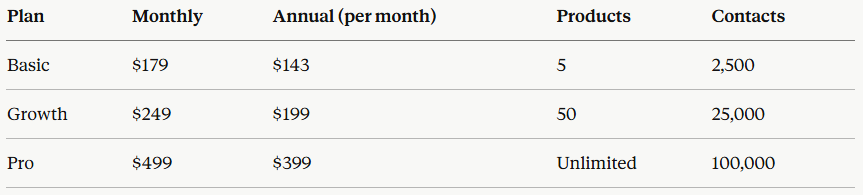
Kajabi overhauled its pricing in January 2026 - the first major restructure in nearly a decade. Prices went up significantly across every tier, and the entry-level Kickstarter plan ($89/month) was removed from the public pricing page entirely. Here's the current structure:
A few things worth flagging immediately.
The contact limit on Basic dropped from 10,000 to 2,500 in the January 2026 restructure. If you have an active email list, you'll hit that ceiling quickly and face an upgrade to Growth at $249/month - a significant jump.
The affiliate program is locked behind Growth. If you're planning to build a referral network as part of your sales strategy, Basic won't support it.
Advanced automations - branching logic, conditional sequences, winback campaigns - are Growth and above. On Basic, your automation capability is limited.
Always verify current Kajabi pricing at kajabi.com/pricing before committing, as Kajabi has shown a willingness to restructure without much warning.
What Kajabi Is Actually Built For
Here's the part most Kajabi pricing posts skip over entirely.
Kajabi is a course platform with marketing features added on. It was built from the ground up to deliver digital courses and membership content, and the email marketing, funnels, and landing pages were layered in over time to reduce the number of tools creators needed alongside it.
That's genuinely useful if your business is centred on course creation and content delivery. But it means some fundamental business tools - a proper CRM, booking and scheduling, robust contact management - are either limited or missing completely.
Community is separate from courses - discussions don't live within the learning flow. A student finishing a module doesn't see a discussion prompt for that lesson - they'd need to leave the course entirely and navigate to a separate community section.
There's no staging area to test major changes before they go live - a real limitation if you're running your entire business website on the platform.
Kajabi limits you to 100 form fields across your whole site - which includes opt-in forms. For a coaching or service business using intake forms, application forms, and feedback surveys, that ceiling arrives faster than you'd expect.
None of this makes Kajabi a bad product. It makes it a specific product - and the Kajabi pricing only makes sense if what it does well maps to what your business actually needs.
For a deeper look at how Kajabi functions as a course platform, this breakdown covers it in full.
Does Kajabi Charge Transaction Fees?
The headline answer is no - Kajabi doesn't charge transaction fees when you use Kajabi Payments. That's a genuine advantage over platforms like Teachable, which charge up to 5% on lower-tier plans.
But there are a few things to understand about how payment processing actually works.
If you use your own Stripe account instead of Kajabi Payments, there's an additional surcharge on top of Stripe's standard rates: 2% on Basic, 1% on Growth, and 0.5% on Pro. The "no transaction fees" claim comes with a condition - you need to use their payment processor.
There's also a longer-term implication worth understanding before you commit. If you build a subscription-based business on Kajabi Payments and later want to leave the platform, your recurring subscriber relationships stay with Kajabi. They're tied to the platform, not portable to you as the creator. Your course content can be rebuilt elsewhere. Your subscription revenue cannot.
That's not a reason to rule Kajabi out - but it's worth understanding upfront, not after you've built your business on it.
Kajabi Pricing vs Building Your Own Stack
The comparison Kajabi's pricing page invites you to make is Kajabi versus paying for five separate tools. And on that comparison, Kajabi often wins - or at least comes close.
The problem is that the comparison only holds if Kajabi actually replaces those tools for your specific business. For course-first creators, it largely does. For coaches, service providers, and online business owners who need strong contact management, booking systems, and deeper automations, the gaps start to matter.
Here's a more honest tool comparison for a coaching or service business:
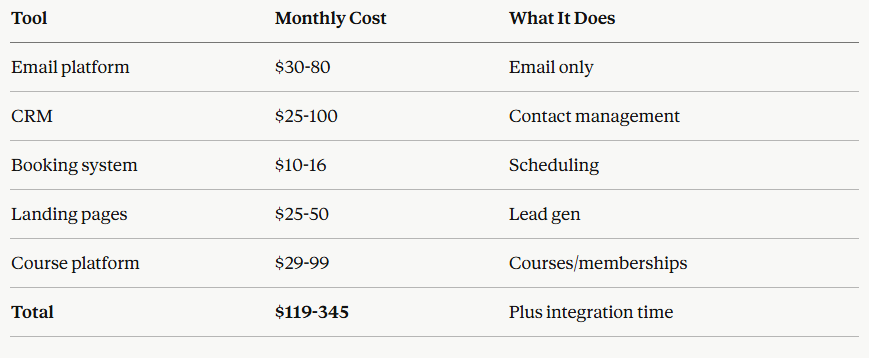
Kajabi Basic at $179/month can genuinely replace most of that list - if you can live with a 2,500 contact limit, limited automations, and no affiliate program. Once you need those features, you're at Growth ($249/month), and the maths changes.
The question isn't just what Kajabi pricing looks like on the plans page. It's what it costs at the tier that actually covers your business needs - not the entry-level plan that looks manageable at first glance.
Which Kajabi Pricing Plan Is Right for Your Stage?

Rather than a feature list, here's a practical read on each plan.
Basic at $179/month - tighter than it looks
The 2,500 contact limit is the main problem here. If you're actively building your list - which you should be - you'll outgrow this faster than the price jump to Growth feels comfortable. No affiliate program and limited automations mean you're also capped on how you can scale. This plan works if you're genuinely just starting out with a single offer and a very small list.
Growth at $249/month - where most established users land
This is where Kajabi starts to function like a proper business backend. Fifty products, 25,000 contacts, the affiliate program, and advanced automations. If you're generating consistent revenue and want to scale, this is the realistic plan - not Basic. Factor this into your thinking from the start rather than starting on Basic and facing a forced upgrade.
Pro at $499/month - for multiple brands or high volume
Three websites, three communities, unlimited products. Built for creators running multiple brands or complex operations. Most coaches and online business owners don't need it.
Kajabi vs ESC Hub: What a True All-in-One Looks Like
Kajabi's pitch is consolidation - one platform instead of five tools. It delivers on that for course creators. But if your business is built around coaching, services, or a mix of offers, the gaps start to matter.
ESC Hub was built for exactly that type of business - coaches, consultants, and online business owners who need their tech to work as a complete system, not a course platform with extras added on.
Here's where the comparison gets practical.
Contact limits - Kajabi Basic caps you at 2,500 contacts. ESC Hub doesn't impose contact limits that force you into a higher tier before you're ready.
CRM - Kajabi's contact management is functional but course-focused. ESC Hub includes a proper CRM built for managing leads, clients, and follow-up across your whole business.
Booking and scheduling - not included in Kajabi at all. Built into ESC Hub.
Support - Kajabi's support at $179-499/month starts with an AI chatbot. ESC Hub members get daily live coaching calls and a team that genuinely knows your business.
Your subscriber relationships - on Kajabi Payments, they stay with Kajabi if you leave. On ESC Hub, your client relationships are yours.
The members who've made the switch tend to say the same thing: they came for the software and stayed for the support. You can read what they actually say at eschub.com/testimonials.
If you're already comparing options, here's a breakdown of the most popular Kajabi alternatives.
Is Kajabi Worth the Price? The Honest Answer
Kajabi pricing is worth it if your business is built around course creation and content delivery, you have consistent revenue to justify the subscription, and you don't need capabilities outside what it was designed for.
It becomes harder to justify if you're a coach or service provider who needs a real CRM, proper booking integration, and the flexibility to manage client relationships beyond course enrolments. You'll find yourself either working around Kajabi's limits or paying for additional tools alongside it - which starts to undermine the all-in-one value entirely.
At $179-499/month, support that starts with an AI chatbot is worth factoring in. And if you're building a subscription business, the payment processor lock-in is worth understanding before you commit, not after.
The platform doesn't build the business regardless of which tool you choose. A clear offer, a defined audience, and a consistent way to bring in leads matter more than which software you run them through.
If you want a platform built for coaches and online business owners from the start - with genuine support included, not bolted on - take a look at what's inside ESC Hub.